Knockout vs Group Stage: 9 Key Betting Differences You Must Know
Listen to the highlights
Audio summary · 0:00
Football Tips
Match Date: 25 Sep 2026| Match | Tip |
|---|---|
| CSD MUNICIPAL vs SUCHITEPEQUEZ | 1 |
| HAMMARBY TFF vs IFK STOCKSUND | 1X |
| SAMA AL SARHAN vs AL AQABA SC | 1X |
| PARNDORF vs FAVORITNER AC | 1X |
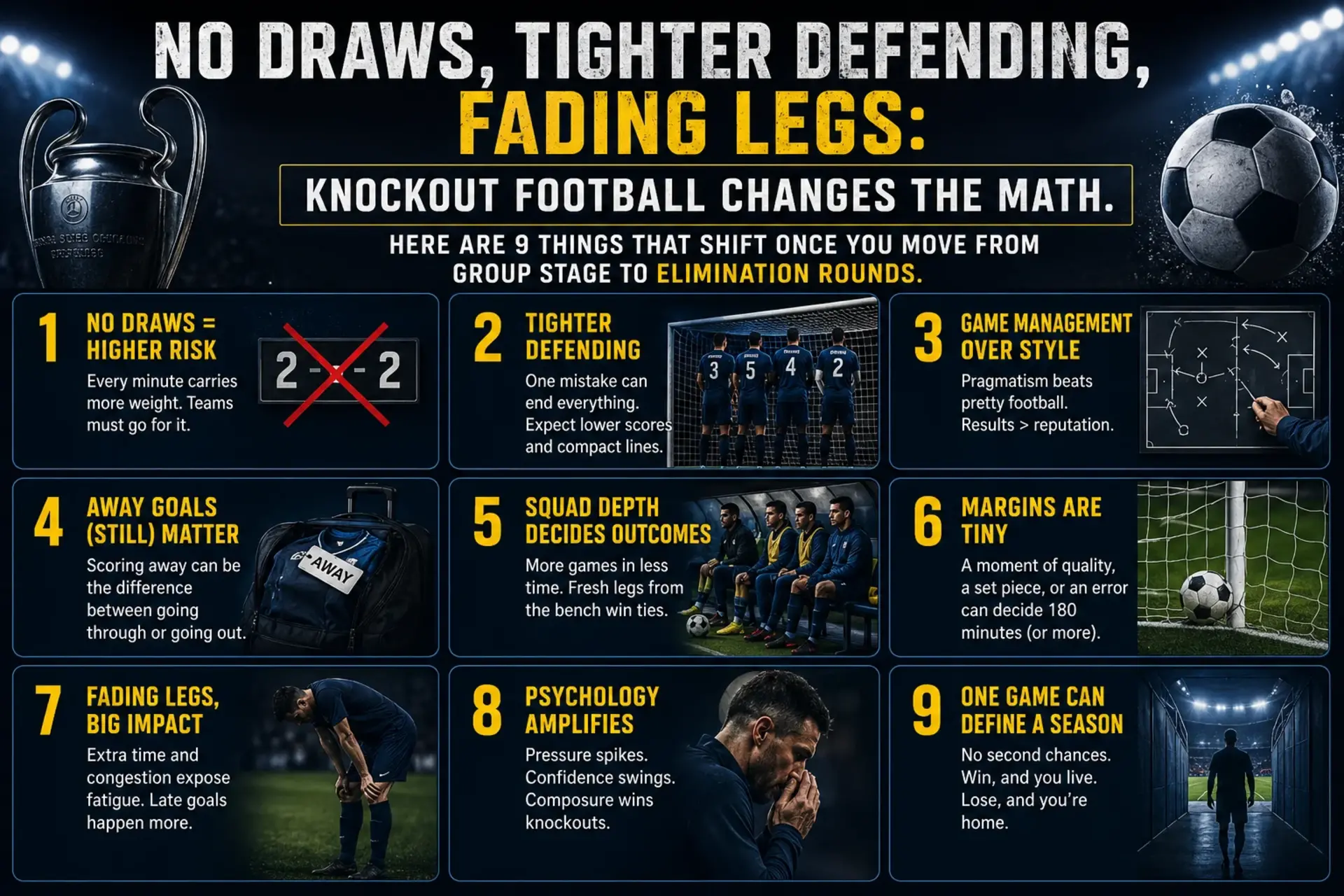
Group stage and knockout football look like the same sport, but the incentives underneath are completely different — and that changes which signals are actually worth paying attention to. With the World Cup moving into the Round of 32, here's what shifts.
1. A draw is no longer a result
The single biggest change: 90 minutes can no longer end level. That pushes more value into extra-time and penalty-related markets than people expect, and it means a team's penalty-shootout history — and their goalkeeper's specifically — suddenly matters in a way it never did during the group stage, where a draw was simply a draw.
2. Favorites get more conservative, not less
It's tempting to assume the stronger side plays the same way with more on the line. In practice, the opposite tends to happen early in knockout rounds: favorites sit deeper, take fewer risks in the buildup, and aim to win the game rather than win it well. Group-stage attacking numbers can overstate how a team will actually play once one mistake ends the tournament for them.
3. Squad fatigue starts to show
By the Round of 32, every team has played three games in under two weeks. The teams that rotated heavily through the group stage generally have an edge in legs over the ones whose starters played all three matches at full intensity — and that gap widens with every round a team keeps advancing.
4. Referees get tighter, not looser
Knockout games carry more on-field tension, and officials tend to manage that with a lower tolerance for cynical fouls and time-wasting, particularly in the closing stages of a tied match. Cards and stoppage time both trend upward compared to equivalent group-stage fixtures.
 5. Head-to-head history matters less than it looks like it should
International knockout draws regularly throw together teams with little or no real history against each other — first-ever competitive meetings between two nations aren't unusual once a tournament's bracket expands. Treat "they've never played each other in this competition" as a normal feature of these rounds, not a gap in the data that needs explaining away.
6. Extra-time and penalty markets carry different value than people expect
Because so few matches actually reach a shootout, public betting attention on these markets is thin relative to how often they actually matter once you're several rounds into a knockout tournament. Thin attention sometimes means mispriced lines — but it also means smaller liquidity, so treat this as a market to understand rather than one to lean on heavily.
7. Team news matters more than usual
A single key absence changes far more in a one-off elimination match than it does across a long league season where a team can absorb a bad week. Confirm starting lineups close to kickoff rather than relying on the squad list from a few days earlier — international squads especially can make late late fitness calls.
8. Set pieces become more decisive
Tighter, more cautious knockout football tends to produce fewer clear-cut chances from open play, which pushes a larger share of goals toward corners, free kicks, and penalties. A team with a strong set-piece routine — or a particularly dangerous penalty taker — gets relatively more valuable the further a tournament goes.
9. "No draw allowed" doesn't automatically mean more goals
It's a common assumption that knockout football is more open because a draw can't stand. In practice the opposite often happens in normal time: teams play more cautiously precisely because the stakes of conceding are higher, and any extra goals tend to arrive in extra time rather than the original 90 minutes.
FAQ
Are penalty shootouts actually predictable, or just a coin flip? Not a pure coin flip — penalty-taking history, goalkeeper save rates, and pressure situations do carry some signal — but the sample size for any single team is always small, so treat shootout predictions as lower-confidence than a 90-minute prediction by default.
Does "home advantage" still matter at a neutral-venue tournament like a World Cup? A genuine home nation still carries crowd and travel advantages even at a multi-host tournament — but for the majority of ties between two visiting nations, the usual home-advantage signal mostly disappears and should be weighted down accordingly.
Should I still trust group-stage form heading into the knockout rounds? It's still the best read on quality you have — just remember the context around that form shifts once elimination enters the picture. A team that scored five goals against a weak group opponent isn't necessarily five-goals-good against a knockout-stage opponent playing for their season.
The takeaway
None of this means group-stage form is worthless. It just means the context around that form needs to shift once elimination enters the picture. We'll be applying these adjustments to our own match-by-match coverage as the knockout rounds play out.
Football predictions, including those referenced in this guide, are for informational purposes only and do not guarantee results. Gambling involves financial risk. Only wager what you can afford to lose, and if gambling stops being fun or starts feeling out of control, reach out for help at BeGambleAware.org. You must be 18 or older to gamble.
This guide was written by the Puntersure Tips editorial team — football betting analysts covering African leagues and European competitions.
Sources & References
Predictions are for informational and entertainment purposes only, not betting advice. See our editorial policy for how content is sourced, reviewed, and corrected. 18+ · Play responsibly.
Related guides
- Live Betting Strategy for World Cup Knockout Games: Pro In-Play Tips
- Live In-Play Betting Guide: Football Live Betting Strategy for African Bettors
- World Cup 2026 Final: Spain vs Argentina Predictions
- World Cup 2026 Live Betting: Knockout In-Play Strategy Guide
- Penalty Shootout Predictions: What Stats Show