Forebet Predictions Today: How the Football Model Works
Every day, millions of football fans across Kenya, Tanzania, Nigeria, and beyond open one tab before placing a single bet: Forebet. It has been online since 2009, and in that time it has become one of the most-cited names in football statistics — not because of clever marketing, but because of a simple, almost stubborn idea: let the numbers decide, not the gut.
But most people who use Forebet every day have never actually looked under the hood. What does that percentage next to the "1" really mean? Why does correct score look so different from 1X2? And is any of it actually worth trusting with real money?
This guide answers all of that in plain language. By the end, you will understand exactly how Forebet predictions are built, what each market means, and how to combine that information with other tools — including Puntersure Tips — to make sharper, more disciplined betting decisions.
What Is Forebet? A Complete Overview
The History and Background of Forebet
Forebet launched in 2009 as a free data and analytics platform built around one tagline that still appears across the site today: "Football is mathematics." The founders set out to build a prediction engine driven entirely by statistical models rather than opinion, tipster gut feel, or paid insider information.
Since then, the platform has grown its database to cover historical results stretching back to the year 2000, processing that data through algorithms that now span more than 850 football leagues and competitions worldwide, alongside select coverage of basketball, tennis, and hockey. The core promise has not changed since launch: every prediction is generated by mathematics, with no human editorial bias added to the underlying probability.
How Forebet Positions Itself Against Tipster Sites
Most football prediction content online falls into one of two camps. The first is tipster-based — a named or anonymous expert shares picks based on personal judgment, scouting reports, or "insider" knowledge. The second is purely statistical, where an algorithm processes historical data and outputs a probability with no human input at all.
Forebet sits firmly in the second camp, and it is explicit about this on its own FAQ page: predictions are based entirely on statistical and mathematical analysis, with no additional human input from the team or anyone else influencing the output. This is the platform's core differentiator. It removes the risk of a tipster being wrong because of bias, a bad day, or a conflict of interest — but it also means Forebet cannot factor in things a human scout might catch, like a manager's tactical tweak that has not shown up in the stats yet.
How Does Forebet Work? The Algorithm Explained
The Core Statistical Model
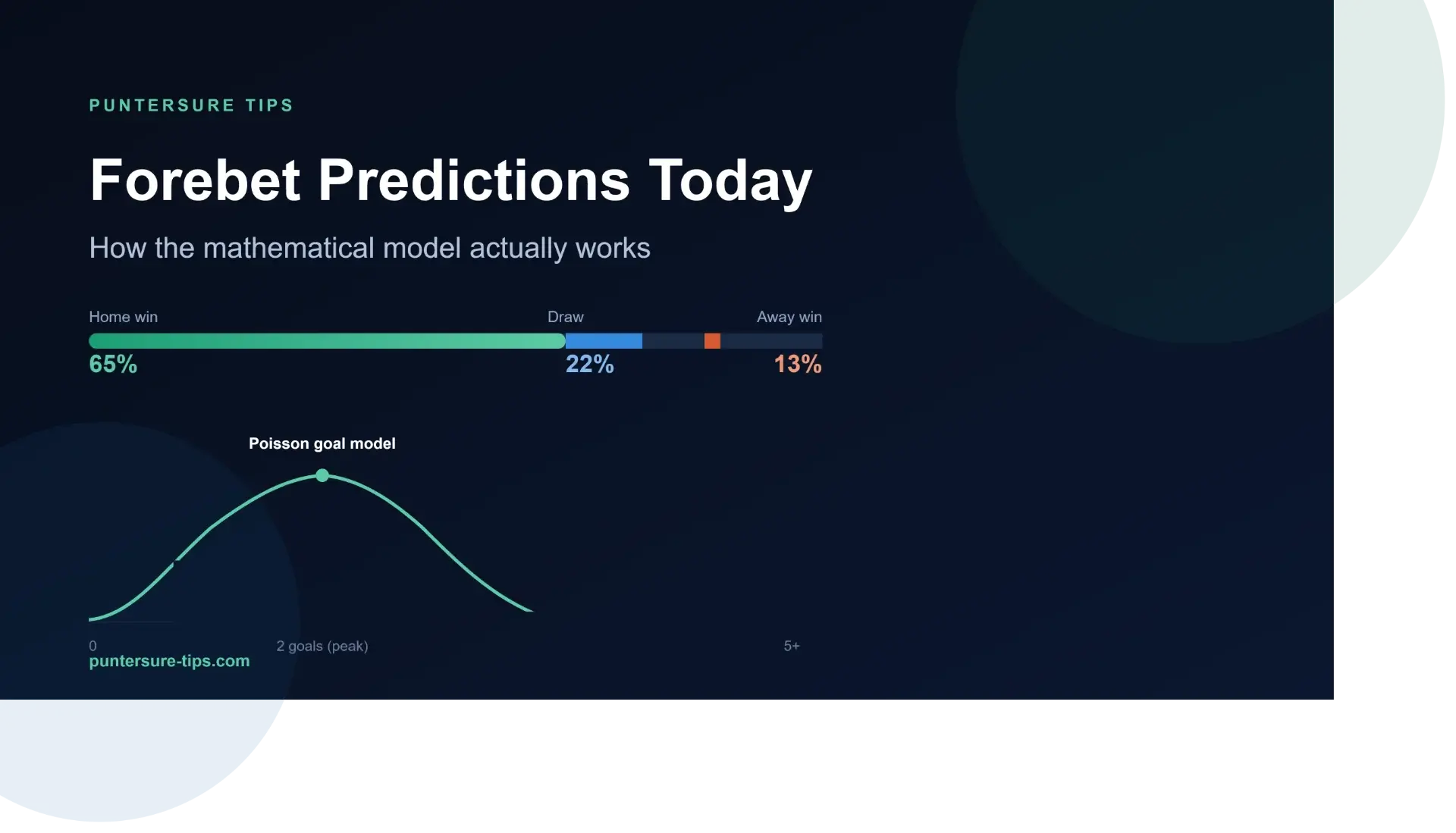
At the center of every Forebet prediction sits a probability engine that processes a match through its database and returns three numbers — one for a home win, one for a draw, one for an away win — that always sum to 100%. The platform simulates matches thousands of times to generate this probabilistic forecast, and the published prediction is simply the outcome with the highest calculated probability.
This matters because the headline label ("1", "X", or "2") is really just a summary of the underlying percentage breakdown. A "1" prediction sitting at 38% home win is a completely different proposition from a "1" prediction sitting at 78%, even though both display the same letter or number on the page.
What Data Does Forebet Analyze?
The model draws on a wide combination of statistical inputs for every fixture it processes:
- Recent form — Results from each team's most recent matches, weighted so the latest games carry more influence than older ones.
- Home and away splits — Teams often perform very differently depending on venue, so Forebet evaluates these records independently before combining them.
- Head-to-head history — Historical results between the two specific clubs, including scorelines and long-running patterns.
- Goals scored and conceded — Attack and defense averages that directly feed the goal-market predictions, including Over/Under and BTTS.
- League standings and table position — Where each side sits affects both motivation and a rough proxy for squad quality.
- Bookmaker odds — Market pricing acts as an additional calibration signal layered on top of the statistical output.
Correct Score and the Poisson Distribution
Forebet's correct score market is its most mathematically demanding output, and it leans on a well-known statistical tool called the Poisson Distribution. This model estimates the likelihood of each team scoring 0, 1, 2, 3, or more goals based on their offensive and defensive strengths, average goals per game, and clean sheet frequency, and the algorithm then combines those probabilities to surface the most statistically likely final scorelines.
It is worth understanding this because it explains why correct score predictions look so different from a simple 1X2 call. A 1X2 prediction only has to separate three buckets. A correct score prediction has to estimate a full goal distribution for both teams independently, then combine them — which is mathematically a much harder problem, and one reason correct score hit rates are dramatically lower than 1X2 hit rates across every prediction platform, not just Forebet.
Reading the Color Coding
One detail that trips up first-time users is the color system layered over the predictions. According to Forebet's own FAQ, predictions highlighted in yellow are for upcoming matches that have not yet kicked off, while green and red apply only to finished games — green meaning the Forebet prediction matched the final outcome, and red meaning it did not. This makes the homepage doubly useful: it is both a forecast tool for upcoming fixtures and a built-in track record you can scroll back through to judge recent performance for yourself.
The Six Betting Markets Forebet Covers
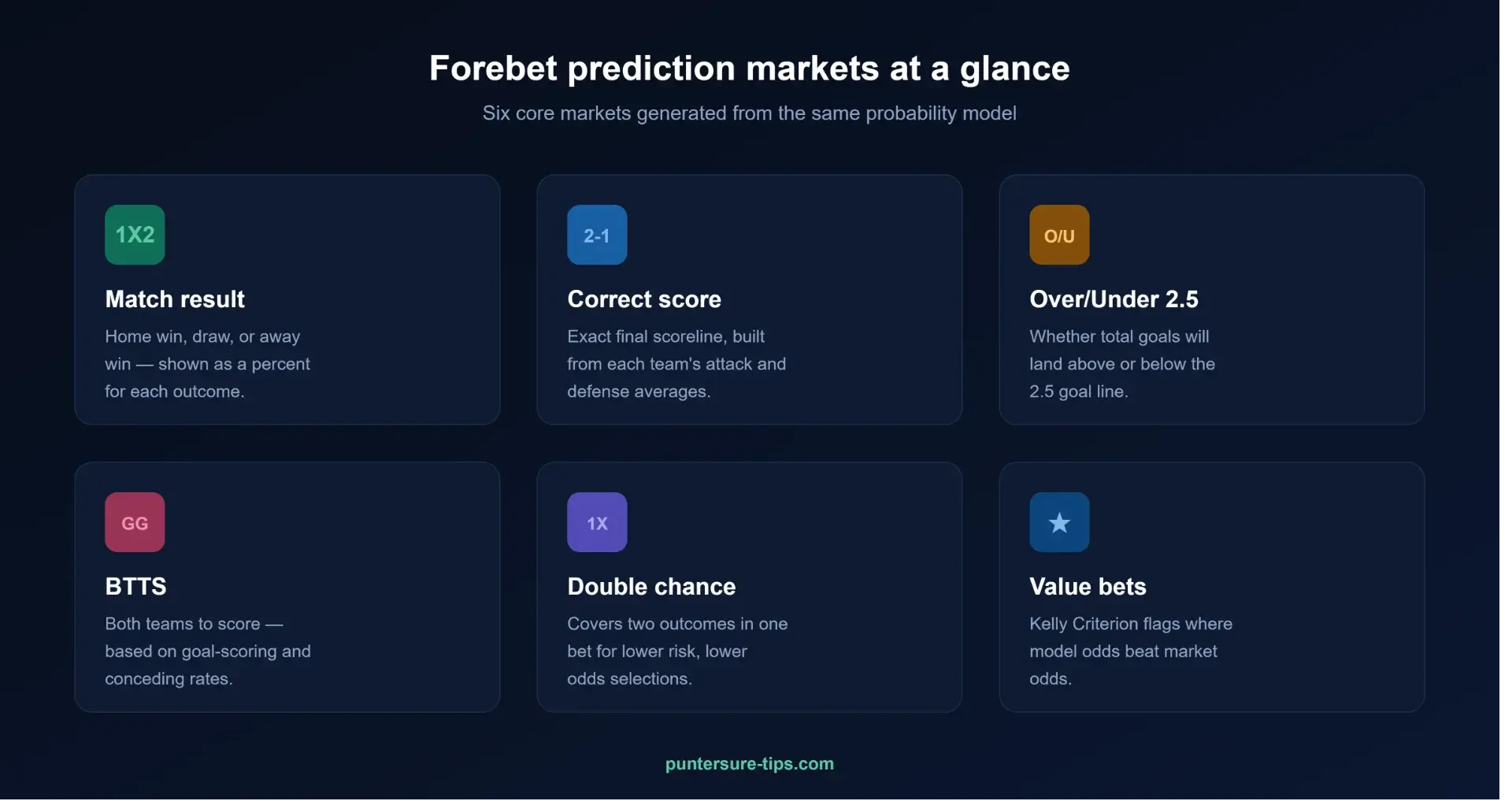
Forebet publishes daily tips across several distinct football betting markets, each suited to different risk appetites and betting strategies.
1X2 — Match Result Predictions
The 1X2 market is Forebet's flagship output and the one most casual users check first. It covers three outcomes — Home Win (1), Draw (X), Away Win (2) — each shown with its own probability percentage. This market works best on fixtures with a clear statistical gap between the two sides; when one team's probability sits well above 60%, that represents a much stronger signal than a near-even three-way split.
Correct Score Predictions
As explained above, correct score tips predict the exact final scoreline using the Poisson-based goal model. These are the hardest market to win across the entire industry — not just on Forebet — and should always be treated as a high-risk, high-reward category rather than a core betting strategy.
Over/Under 2.5 Goals
By combining both teams' attacking and defensive averages, the model generates a probability for whether the match will finish with more than 2.5 total goals (Over) or fewer (Under). This market tends to perform strongly in high-scoring leagues like the Bundesliga and Eredivisie, and on the Under side in historically tighter leagues like Serie A.
BTTS — Both Teams to Score
Also written as GG, this market predicts whether both sides will find the net at least once, independent of the final result. Matches involving two attack-minded, defensively leaky teams are natural BTTS candidates, while fixtures with one dominant defense and a toothless opponent lean toward the No Goal alternative.
Double Chance
Double Chance tips combine two outcomes into one bet — Home or Draw (1X), Away or Draw (X2), or Home or Away (12) — trading lower odds for a meaningfully higher probability of winning. This is a sensible entry point for newer punters who want to use Forebet's underlying data without taking on full single-outcome risk.
Value Bets via the Kelly Criterion
This is the market most casual users overlook, and arguably the most analytically interesting one on the site. Forebet's algorithm uses the Kelly Criterion to compare its own calculated probabilities against the official bookmaker odds, grouping the matches with the best ratio between the two into a dedicated Value section — the fixtures most likely to offer a profitable edge if the prediction proves correct. A separate Top Predictions section overlaps with this list but filters further, surfacing only the games where a single outcome carries roughly 50% probability or higher, prioritizing lower-risk selections over pure value-hunting.
How Accurate Is Forebet, Really?
This is the question every punter eventually asks, and the honest answer sits in a range rather than a single number. Forebet's own marketing has at times pointed to figures above 75% on its strongest markets, but independent reviews tend to land more conservatively. One detailed third-party review concluded that while Forebet claims an overall accuracy rate above 75%, independent testing suggests the true figure is closer to 65-70% on average — and contextualized that number by noting it still translates to roughly two correct calls out of every three matches, which is a respectable strike rate given the sheer scale and unpredictability of football.
It helps to break this down by market rather than treating "Forebet accuracy" as one single statistic:
- 1X2 predictions perform best on lopsided fixtures with a clear favorite, and weaker on closely matched games where the three-way split is near-even.
- Over/Under 2.5 tends to be one of the more reliable goal markets, particularly in leagues with consistent scoring patterns.
- Correct score carries the lowest hit rate of any market on the site, which is true of every prediction platform — not a Forebet-specific weakness, simply a reflection of how mathematically difficult exact-score forecasting is.
- Value bets are not designed to "win" in the traditional sense at all; they flag where the model's price differs from the market's price, which is a longer-horizon strategy rather than a single-match accuracy claim.
The practical takeaway: treat the published percentage as the real signal, not the one-letter outcome label. A 78% home win prediction and a 41% home win prediction both display "1" on the page, but they represent very different levels of conviction from the underlying model.
How to Use Forebet Predictions Effectively
Filter by Probability, Not Just the Outcome Label
Forebet covers hundreds of matches across dozens of leagues every single day, and not every fixture is worth a bet. The single most useful habit a new user can build is reading the actual percentage rather than the headline label. Many experienced punters set their own personal threshold — commonly somewhere around 65-70% — and only seriously consider predictions that clear it.
Use the Value Section for a Different Kind of Edge
Most users only ever check the main 1X2 list and skip the Value and Top Predictions sections entirely. These two filtered lists exist precisely because raw probability and betting value are not the same thing — a 70% favorite at very short odds can be a worse bet than a 55% pick priced generously by the bookmaker. Checking both views before committing gives a fuller picture than either alone.
Cross-Reference With Other Sources
No single prediction platform is infallible, including Forebet. The smarter approach treats it as one input layered with other context: team news such as injuries and suspensions, fixture congestion, weather, and match stakes (cup tie versus routine league fixture). Platforms like Puntersure Tips add a further analytical layer on top of this kind of statistical baseline by incorporating consistency scoring, AI-powered match simulations, and dedicated coverage of the Kenyan Premier League and other African competitions that global platforms do not always prioritize.
Track the Color-Coded History Before You Trust a League
Because Forebet leaves its green-and-red track record visible on the homepage, there is no excuse for skipping this step. Before leaning heavily on tips from any one league, scroll back through a week or two of results in that specific competition and see how the model actually performed there. Accuracy is not uniform across 850+ leagues — a model that nails the Premier League consistently might be far shakier in a lower-tier league it has less historical data for.
Build Small, Disciplined Accumulators
Stacking high-probability Forebet picks into a large accumulator is tempting because the combined odds look attractive on paper, but each additional leg compounds risk sharply. A disciplined 2-3 match accumulator built from selections above your personal confidence threshold will outperform a 10-leg parlay over the long run, because a single unexpected red card or late goal can unravel an otherwise well-researched slip.
How Forebet Compares to Other Prediction Sites
Forebet vs. Statarea
Both platforms share the same philosophical foundation — pure statistical modeling with no tipster input — and both cover hundreds of leagues for free. Statarea's interface tends to favor compact, code-heavy displays of probabilities, while Forebet leans toward a cleaner layout with more visual elements like trend write-ups and a derby slider on the homepage. Functionally, the two are close enough that many serious punters check both before settling on a final selection.
Forebet vs. PredictZ
PredictZ blends statistical modeling with editorial-style match previews, giving it a slightly more human-readable feel than Forebet's pure-numbers approach. Forebet's larger league database and explicit Kelly Criterion value section give it an edge for punters who want to dig into probability math directly rather than read prose analysis.
Forebet vs. Vitibet
Vitibet also runs a probability-based model but leans more heavily on bookmaker odds as a direct input. Forebet derives its probabilities more directly from match data and team statistics, which insulates its output somewhat from bookmaker pricing distortions — a distinction that matters most for punters specifically hunting value bets rather than straightforward outcome predictions.
Forebet vs. Puntersure Tips
Puntersure Tips builds on the same kind of statistical foundation that powers Forebet, then layers on AI-driven match simulations, a proprietary Consistency Score for every prediction, and dedicated focus on the Kenyan Premier League and other African leagues that sit lower on the priority list for most global prediction engines. Where Forebet hands you a raw probability breakdown across 850+ leagues, Puntersure Tips translates that kind of data into ranked, confidence-rated daily tips built specifically around what punters across Kenya and East Africa are actually betting on.
Tips for First-Time Forebet Users
Start With the Top Predictions List
If this is your first visit to Forebet, the Top Predictions section is the better starting point over the full daily fixture list. It pre-filters down to matches where the model shows higher conviction, giving new users a manageable, focused entry point before exploring the broader database.
Understand That a Percentage Is a Probability, Not a Promise
Even a 90% prediction loses roughly one time in ten. That is not a flaw in the model — it is simply what probability means. Treat every Forebet figure as informed likelihood rather than a guarantee, and your expectations (and your bankroll) will stay realistic over a long stretch of betting.
Respect Bankroll Management Above Everything Else
No prediction platform, however well-designed, can remove football's inherent unpredictability. Disciplined punters stake a fixed, small percentage of their total bankroll per selection — commonly in the 1-5% range — which absorbs inevitable losing streaks without wiping out the betting fund entirely. This single habit matters more for long-term results than any individual prediction does.
Final Verdict: Is Forebet Worth Using?
Yes. Forebet remains one of the most established free football prediction platforms online, with a database stretching back to 2000, coverage across 850+ leagues, and a transparent, purely mathematical methodology that has not wavered since its 2009 launch. Its built-in green-and-red track record is a genuinely useful, often-overlooked feature that lets any user audit the model's recent performance before trusting it with real money.
That said, Forebet works best as one well-built input inside a broader research process rather than a standalone decision-maker. Layering its probability data with current team news, a personal confidence threshold, and additional analytical tools — including Puntersure Tips' consistency scoring and East Africa-focused coverage — gives you a far more complete picture before placing any bet.
If you want daily football predictions built around statistical rigor alongside AI-powered match simulations, Kenyan Premier League expertise, and free tips delivered straight to Telegram, Puntersure Tips is built specifically to help African punters bet smarter, not harder.
The content on this page is for informational purposes only. Football betting involves risk. Please gamble responsibly and only stake what you can afford to lose.
Sources & References
- Forebet Official Site
- Forebet FAQ — Official Methodology
- Forebet Soccer Picks System
- Football Predictions Forebet — Google Play
- Betting-Sites.co.ke In-Depth Forebet Review
- Quantum Sports Betting — What Is Forebet
- ZonalSports Forebet Overview and Review
- JoeOdds Forebet Free Tips Today
- Footiehound Forebet Predictions Guide
- TodaysPredict Forebet Analysis
Predictions are for informational and entertainment purposes only, not betting advice. See our editorial policy for how content is sourced, reviewed, and corrected. 18+ · Play responsibly.