Penalty Shootout Predictions: Are They Ever Reliable?
Listen to the highlights
Audio summary · 0:00
Football Tips
Match Date: 30 Sep 2026| Match | Tip |
|---|---|
| KHOVD vs FC ULAANBAATAR | X2 |
| HAPOEL IRONI ARRABA vs HAPOEL MIGDAL HAEMEK | 2 |
| CIENCIANO vs LOS CHANKAS | 1 |
| DEP.INDEPENDIENTE MEDELLIN vs MILLONARIOS | X2 |
Germany have won the World Cup four times and had never lost a penalty shootout at one, winning six of their previous seven. On June 29, that streak ended. Paraguay, ranked 41st in the world, held Germany to a 1-1 draw through extra time and won the shootout 4-3, in what is already being called one of the biggest upsets in World Cup history.
Germany was not the only shootout that day. Morocco beat Netherlands on penalties too, in another Round of 32 tie level after extra time. Two shootouts from a single day of matches, in a Round of 32 that was still not even half finished, with more knockout matches, and statistically more shootouts, still to come before the Round of 16 even begins. Both shootout winners now walk straight into another single-elimination test: Paraguay face France, and Morocco face Canada. Every one of those ties raises the same question for anyone trying to make accurate penalty shootout predictions: once a match reaches penalties, does data still matter?
What Actually Happens Once a Match Reaches Penalties
 A shootout is five kicks per team, then sudden death if scores are level. Everything before that, the 90 minutes plus extra time, is where form, tactics, and head-to-head history genuinely shape the outcome. That is also where prediction models, including Puntersure Tips' own match analysis, spend most of their analytical weight.
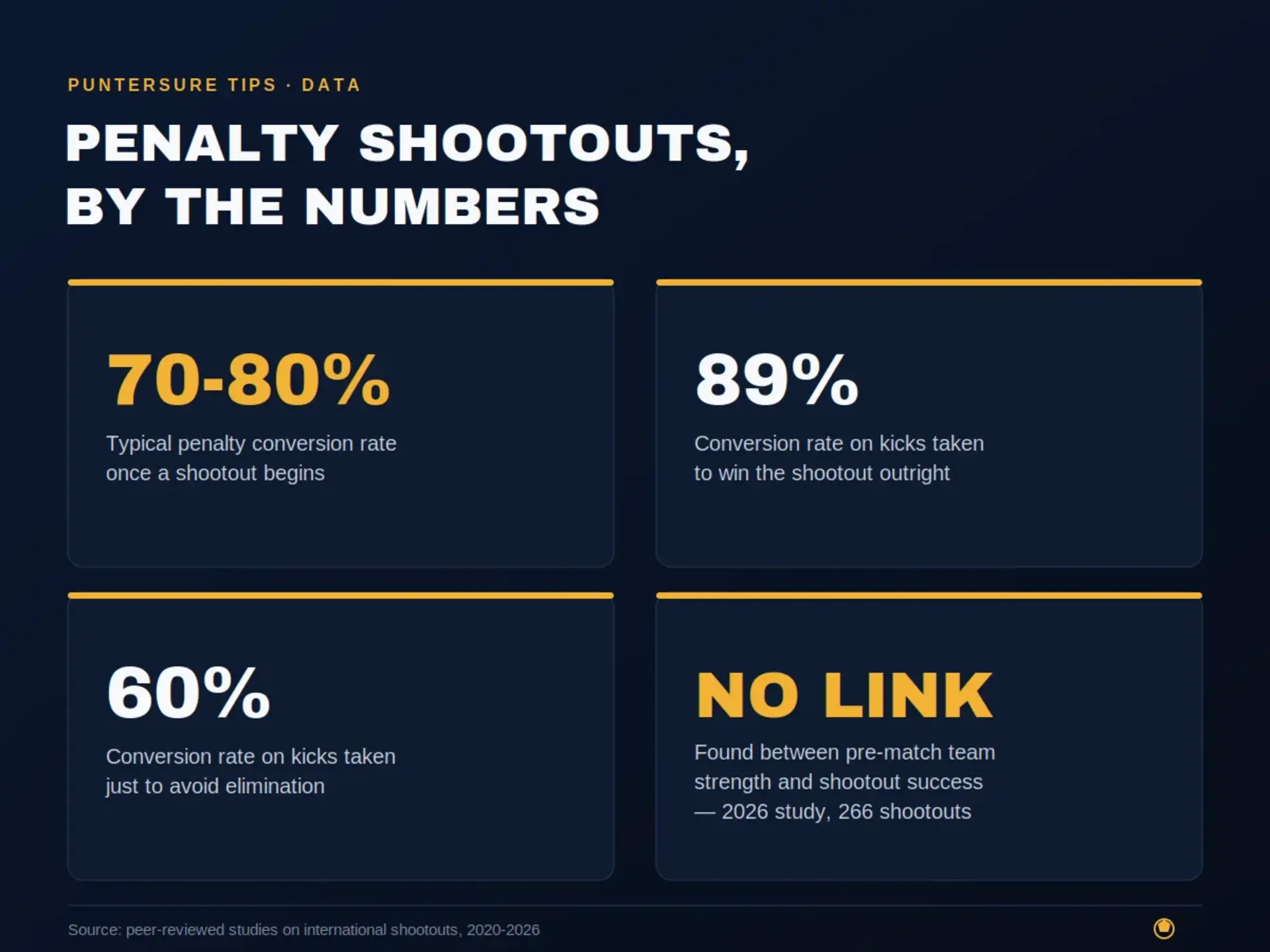
The shootout itself behaves differently. Large studies of professional football put the overall penalty conversion rate at roughly 70 to 80 percent, whether the kick comes during open play or in a shootout. That average hides a lot of movement underneath it:
- Early, low-pressure kicks (rounds one and two) are converted around 75 percent of the time
- Kicks taken purely to avoid elimination convert at a noticeably lower 60 percent
- Kicks taken to win the shootout outright convert at a striking 89 percent
That last figure is worth sitting with. A kick with the tournament on the line is not automatically the hardest one to take. It is often the simplest, because the job is clear: score and it is over. Missing to stay alive seems to carry a heavier psychological weight than missing to win.
Does Shooting First Actually Help?
The Old Story: A 60 Percent Edge
For years, the accepted wisdom in football analytics traced back to research by economist Ignacio Palacios-Huerta, who found that teams taking the first kick in a shootout won around 60 percent of the time across more than a thousand shootouts. Several follow-up studies landed in a similar range, and the figure became one of the most widely repeated stats in the sport.
It mattered enough that some competitions experimented with an alternating "ABBA" kicking order at lower levels, specifically to remove the first-kicker advantage from the equation.
What the Newest Research Found
A 2026 study of 268 penalty shootouts in European club competitions found no statistically significant advantage for the team that kicks first. That lines up with the two largest studies on record, covering more than 1,700 and over 7,000 shootouts respectively: neither found evidence that shooting order affects the outcome.
In short, the "60 percent" figure that gets quoted casually looks like it was picking up noise and small-sample variation more than a durable edge. Treat kicking order as background trivia, not a factor to weigh in a prediction.
Do Better Teams Actually Win Shootouts?
This is the question that matters most for anyone reading match odds, and the answer is uncomfortable for data-driven prediction. The same 2026 study found no reliable relationship between a team's pre-match strength rating and its odds of winning a shootout.
Germany vs Paraguay is a near-perfect illustration. Germany had 75 percent possession and outshot Paraguay 21 to 7. On expected goals, Germany's underlying performance was miles ahead. None of that carried over once the match reached the penalty spot.
This is the idea worth taking away: a shootout does not simply extend the 120 minutes that came before it. It resets the contest into a much narrower, much noisier event, one where a team's season-long quality stops being the main variable.
Some teams carry that risk more than others. Switzerland have gone to penalties in five of their last nine knockout matches at major tournaments, losing four of those five shootouts, and have won just one of their last twelve knockout matches inside normal time. Their underlying form barely factors into that particular pattern.
None of this means underlying quality is irrelevant. A stronger team is still more likely to win the match outright inside 90 or 120 minutes, and a stronger team is still more likely to avoid a shootout altogether by scoring the extra goal it needs. The finding is narrower than "quality does not matter." It is that once the coin is effectively flipped, quality stops being the thing doing the predicting.
What Actually Moves the Needle, Even Slightly
Pressure Changes Shooters, But Not Evenly
The conversion-rate gap between "must score to survive" and "score to win" kicks, covered above, is one of the more consistent findings in this research. It suggests shootout pressure is not one uniform force. How a kick is framed in a player's head, as a chance to finish the job or a threat of elimination, changes how it tends to be taken.
This has a practical echo in how shootouts tend to unfold. Pressure builds for both sides at the same time, but it does not build evenly: the team facing a must-score kick to survive is working from a tougher psychological baseline than the team one kick away from closing it out.
Researchers at the University of Queensland, who modeled hundreds of elite penalties and millions of simulated shootouts for a 2026 study, found something else worth knowing: the order individual kickers go in matters more than which team kicks first. Sides that put their most pressure-resistant takers early, rather than saving them for a dramatic final kick, won more often in their simulations, by more than 10 percentage points.
Goalkeepers With Shootout Experience Save More
Research into shootout lineups has found a link between a goalkeeper's international experience and shootout save success, separate from the team's overall quality. Preparation plays a role too, even if the popular version of one famous story gets exaggerated.
The go-to example is Louis van Gaal substituting goalkeeper Tim Krul on for the 2014 World Cup quarter-final shootout against Costa Rica purely for the penalties. Krul saved two spot kicks and the Netherlands won 4-3. Krul has since said the legend of him reading from a written cheat sheet is not quite accurate: he had studied Costa Rica's regular takers closely, but the information was in his head, not on paper. The scouting was real. The prop was folklore.
What This Means When You're Reading Knockout Odds
The practical takeaway is not "shootouts are unpredictable, ignore them." It is that they need a different kind of thinking than a 90-minute prediction does:
- Pre-match form and head-to-head data are genuinely useful for the 90 (or 120) minutes. Their value drops sharply once a match reaches the penalty spot.
- A tie is more likely to reach penalties when two sides are closely matched and cautious, which is common in the later rounds of a 48-team World Cup where one mistake ends the tournament.
- Markets built around who wins a shootout outright are closer to a coin flip than a form-based pick, regardless of which side is favored on paper.
Paraguay and Morocco are a live test of this idea. Both now walk straight into the Round of 16 off the back of a shootout, against France and Canada respectively, and both will be treated as clear outsiders on paper. The data above is a reasonable starting point for judging 90 minutes of football. It says nothing at all about what happens if either tie is still level after 120.
This is also why an honest confidence score is more useful than a confident-sounding one. A model that backs a strong team for the 90 minutes, while flagging a genuine coin-flip once a tie could go to penalties, is doing its job properly, even when that means admitting the limits of what data can call. For the bigger picture on how the two phases of a knockout tie differ, see our guide on what changes between group-stage and knockout football.
Frequently Asked Questions
Penalty shootout?
A penalty shootout is a tiebreaker in football used to decide a match that is still drawn after extra time. Each team takes alternating penalty kicks, and the team with more goals after five kicks each wins, or sudden death decides it if still level.
Penalty shootout game?
A penalty shootout game is a football-based game where players take and save penalty kicks, either as a video game, browser game, or virtual betting product. It can also refer to a training drill in real football.
Penalty shootout rules?
Each team takes five kicks from the penalty spot, alternating between the two teams. If the score is level after five kicks, the shootout goes to sudden death, where each team takes one additional kick until one team scores and the other misses.
Penalty shootout casino?
Penalty Shootout is a virtual football game offered by some online casinos and bookmakers, not a traditional casino table game. You bet on simulated outcomes such as the winning team, total goals, or whether both teams score.
Penalty shootout arsenal vs psg?
There has been no competitive penalty shootout between Arsenal and PSG. Their recent meetings were decided in normal time, so any shootout result you saw was likely from a virtual game, friendly tournament, or fan simulation.
Penalty shootout meaning?
A penalty shootout is a method of deciding a drawn football match after extra time. It consists of a series of penalty kicks taken by both teams to determine the winner.
Penalty shootout in football?
In football, a penalty shootout is the official tie-breaker used in knockout matches when the score is level after extra time. It is governed by the Laws of the Game and is not used in league or group-stage matches.
Penalty shootout 1xbet?
On 1xBet, Penalty Shootout is a virtual football game where you bet on the outcome of a simulated penalty shootout. Markets include the winner, total goals, and other shootout-related outcomes.
Penalty shootout between arsenal and psg?
There has been no official penalty shootout between Arsenal and PSG. Their competitive meetings have all been decided in normal time, so a shootout result would come from a virtual or non-competitive event.
Who will win penalty shootout?
No one can predict a penalty shootout with certainty. Bookmakers set odds based on team quality, goalkeeper ability, and historical shootout data, but shootouts are high-variance and often unpredictable.
Has england ever won a penalty shootout?
Yes, England have won several senior men’s penalty shootouts, including against Spain at Euro 96, Colombia at the 2018 World Cup, Switzerland in the 2019 Nations League, and Switzerland again at Euro 2024.
When penalty shootout is given in football?
A penalty shootout is given when a knockout match is still drawn after extra time. It is not used in group-stage or league matches, where a draw is allowed to stand.
Sources:
https://www.thefa.com/football-competitions-governance/laws-of-the-game
https://en.wikipedia.org/wiki/Penalty_shootout_(association_football)
https://www.1xbet.com/
Football predictions, including those referenced in this guide, are for informational purposes only and do not guarantee results. Gambling involves financial risk. Only wager what you can afford to lose, and if gambling stops being fun or starts feeling out of control, reach out for help at BeGambleAware.org. You must be 18 or older to gamble.
This guide was written by the Puntersure Tips editorial team — football betting analysts covering African leagues and European competitions.
Sources & References
Predictions are for informational and entertainment purposes only, not betting advice. See our editorial policy for how content is sourced, reviewed, and corrected. 18+ · Play responsibly.
Related guides
- SoccerPunter.com Guide: Soccer Predictions, Statistics & Buyer Awareness
- SoccerVista Football Predictions & Tips Guide
- World Cup 2026 Final: Spain vs Argentina Correct Score Prediction
- World Cup 2026 Final: Spain vs Argentina Predictions
- Live Betting Strategy for World Cup Knockout Games: Pro In-Play Tips